Choosing a forex broker is one of the most consequential decisions a trader makes, yet it rarely gets the forensic attention it deserves.
Regulation, spreads, platform quality, and leverage caps all vary considerably between providers, and what suits an active day trader is not going to suit someone placing a handful of macro trades a month.
Our Forex Brokers guide reviews seven of the most widely used forex brokers currently operating in 2026, drawing on our expert research along with verified data to give you an accurate picture of what each one actually costs and how it works.
The 7 Best Forex Brokers Ranked for 2026
- eToro: Best for social and copy trading
- CMC Markets: Best for currency pair range and platform tools
- XTB: Best for beginners and commission-free trading
- Pepperstone: Best for active traders and tight raw spreads
- Saxo: Best for multi-asset, institutional-grade trading
- Capital.com: Best for low minimum deposit and AI-assisted tools
- Spreadex: Best for UK spread betting with fixed spreads
Brokers At a Glance
- eToro: Regulated by the FCA, CySEC, and ASIC, with 50+ currency pairs, maximum retail leverage of 30:1, an average EUR/USD spread of 1.0 pip, a minimum deposit of $50–$200, and a rating of 4.0/5.
- CMC Markets: Regulated by the FCA, ASIC, MAS, BMA, and FMA, with 330+ currency pairs.
- XTB: Regulated by the FCA, KNF, CySEC, BaFin, CNMV, and DFSA, with 50+ currency pairs.
- Pepperstone: Regulated by the FCA, ASIC, CySEC, BaFin, DFSA, SCB, SCA, and CMA, with 100+ currency pairs.
- Saxo: Regulated by the Danish FSA, FCA, ASIC, MAS, and FINMA, with 185+ currency pairs.
- Capital.com: Regulated by the FCA, ASIC, and CySEC, with 138 currency pairs.
- SpreadEx: Regulated by the FCA, with 60+ currency pairs.
eToro minimum deposit varies by region ($50–$200 is most common). Saxo Classic minimum deposit varies by source; some entities give no formal minimum. Verify with the broker directly before opening an account.
Best Forex Trading Platforms Reviewed
1. eToro: Best for Social and Copy Trading
eToro was founded in 2007 and has built its reputation almost entirely on what it calls social trading. Its CopyTrader™ feature allows users to replicate top-performing investors, making trading accessible even to beginners. The platform offers CFD trading in 50+ foreign exchange (forex) pairs, allowing leverage of up to 30:1 on the major currency pairs.

eToro is regulated by CySEC, FCA, and ASIC. Although the CFD trading account is commission-free, spreads start at 1.0 pips on the EUR/USD, which is wider than those of other similar brokers. There is an inactivity fee of $10 per month after 12 months of inactivity. Its high-definition charts are powered by TradingView, and the broker further improves its offering with the Delta trading app-a sleek, multifunctional tool for trading on the go.
The platform does not support automated trading, which rules it out for algorithmic traders. In August 2025, eToro launched a suite of AI tools that allow users to build investments on the community marketplace; the feature was initially available to a group of vetted investors, whose trades and portfolios can be copied by other users.
For beginners, the platform makes life easy, and advanced traders have nearly everything they need, so eToro comes at the top of our list as an easy recommendation for practically everyone.
Best For: Social and copy trading with its innovative CopyTrader™ feature that lets users automatically mirror top-performing traders
Pros:
- Commission-free trading
- CopyTrader and Smart Portfolios
- Regulated by three top-tier authorities
- TradingView-powered charts
Cons:
- No automated trading support
- $10/month inactivity fee after 12 months
| Avg EUR/USD Spread | 1.0 pip |
| Max Leverage | 30:1 (retail) |
| Min Deposit | $50–$200 (region-dependent) |
2. CMC Markets: Best for Currency Pair Range and Platform Tools
Founded in 1989, CMC Markets is a well-known forex and CFD broker with a high trust rating and a huge range of financial instruments to trade. It is one of the few brokers on this list whose instrument selection extends to over 330 currency pairs. With competitive pricing and almost 12,000 instruments spanning virtually every market and asset class, CMC Markets is a great choice for global forex and CFD traders.
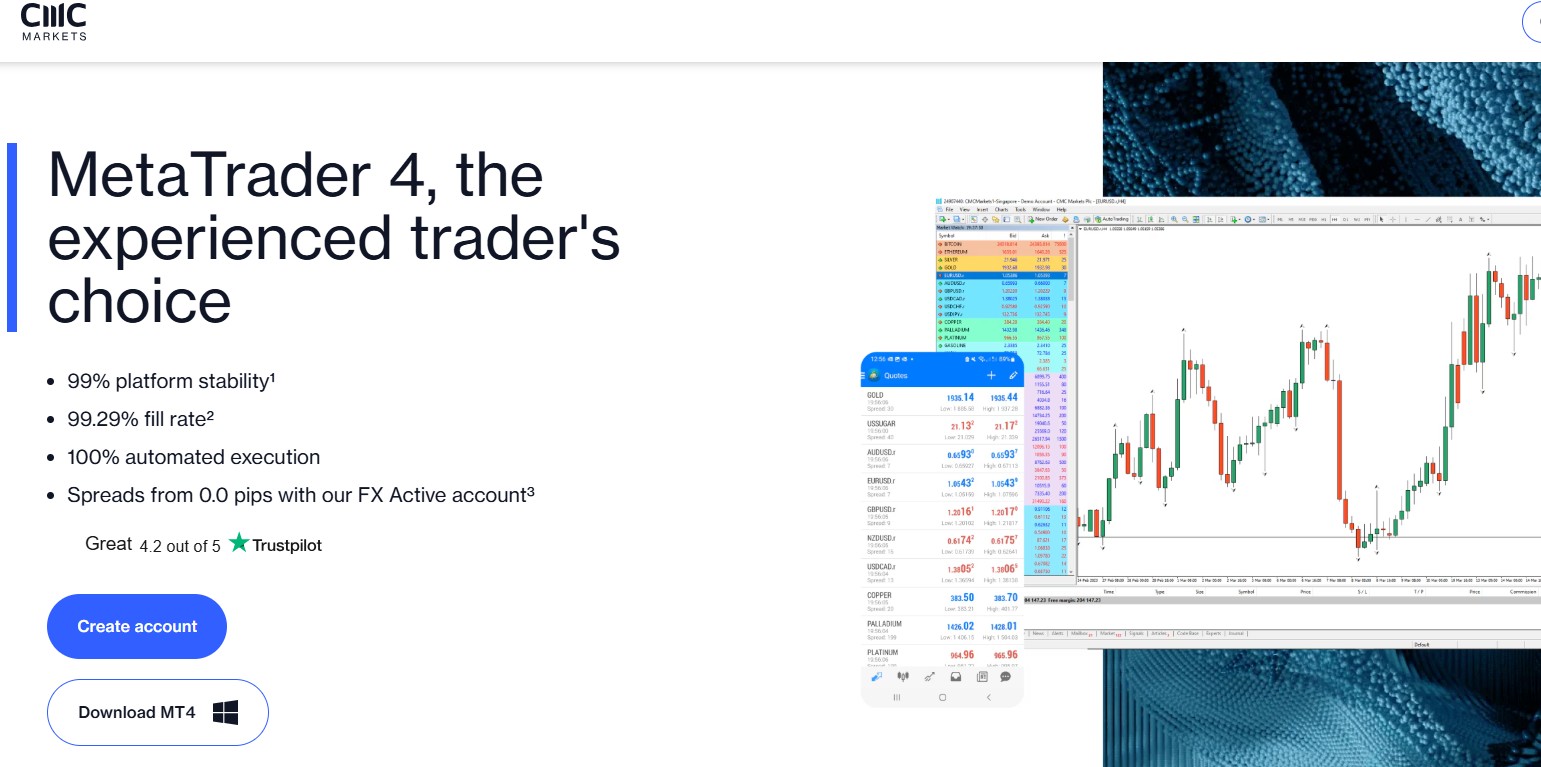
Regulated by the FCA in the UK, BaFin in Germany, MAS in Singapore, and CIRO in Canada, CMC Markets provides high-tier investor protection, negative balance protection, and segregated client accounts. CMC Markets offers two live accounts with no minimum deposit requirements – a low-cost commission-free account with spreads starting at 0.7 pips on the EUR/USD and a commission-based account with spreads of 0 pips and commissions of 5 USD round turn, one of the lowest in the industry.
The spread for the EUR/USD on CMC Markets’ standard account offering on MetaTrader comes in at 1.3 pips as per June 2025 data. Trading is offered on MT4, MT5, TradingView and its own NextGen platform that features numerous technical and fundamental analysis tools.
Best For: Traders seeking maximum currency pair choice with over 330 pairs and its low-cost FX Active raw spread account
Pros:
- 330+ currency pairs
- No minimum deposit
- Two distinct account types including FX Active for active traders
- MT4, MT5, and TradingView support
Cons:
- Currency conversion fee of up to 0.5%
- No US clients
| Avg EUR/USD Spread | 0.7 pip (standard); 0.65 pip avg (FX Active) |
| Max Leverage | 500:1 (offshore); 30:1 (UK/EU/AU retail) |
| Min Deposit | None |
3. XTB: Best for Beginners and Commission-Free Trading
XTB has spent most of the past two decades being a Polish-headquartered institutional success story that never quite got enough retail attention outside Europe. That’s changing. XTB reported serving over 1.9 million clients globally as of its Q3 2025 update.
XTB maintains offices in over a dozen countries across Europe and is regulated by multiple authorities, including the UK’s FCA, Poland’s KNF, Germany’s BaFin, Spain’s CNMV, France’s AMF, Cyprus’ CySEC, the UAE’s DFSA, South Africa’s FSCA, the FSA of Seychelles, and Belize’s FSC.
In 2025, XTB streamlined its pricing options, now providing a singular, no-commission spread structure. Previously, they catered to diverse trading needs with a Pro Account featuring raw spreads; however, this option has been phased out, leading to a unified approach with the Standard Account. Using data from Q3 2025, XTB average forex spreads on the EUR/USD stood at 0.92 pip. XTB does not require a minimum deposit to start trading, although they recommend a minimum of $250.
Its xStation 5 platform is well designed and packed with innovative features, and XTB’s comprehensive education and research helped the broker finish Best in Class for Overall, Ease of Use, and Beginners in 2026.
Best For: Beginners, thanks to its award-winning “Best in Class for Beginners 2026” xStation 5 platform, strong educational resources, and fully commission-free trading
Pros:
- No minimum deposit
- Strong multi-jurisdiction regulation
- Award-winning xStation 5
- Competitive 0.92 pip EUR/USD average spread
Cons:
- Pro account phased out in most regions, reducing options for high-volume traders
- Inactivity fee applies after 12 months
| Avg EUR/USD Spread | ~0.92 pip |
| Max Leverage | 500:1 (offshore); 30:1 (EU/UK retail) |
| Min Deposit | $0 |
4. Pepperstone: Best for Active Traders and Tight Raw Spreads
Pepperstone, founded in 2010, is regulated by top-tier authorities including the Australian Securities and Investments Commission (ASIC), the UK Financial Conduct Authority (FCA), and the Cyprus Securities and Exchange Commission (CySEC). The broker has expanded its regulatory footprint to include licenses in Germany, Kenya, the United Arab Emirates (Dubai), and the Bahamas, ensuring compliance across diverse jurisdictions.
Pepperstone offers two primary accounts – the Standard and Razor – designed to cater to the trading needs of beginners through to advanced traders. These accounts feature competitive pricing: spreads start from 0.0 pips on the Razor account. The Standard account offers traders a commission-free pricing model where all trading costs are embedded within competitive spreads, which start from 1.0 pips in Forex.
Leverage available varies by region and asset class, with Forex and metals offering up to 400:1 leverage in regions such as Kenya, while more strictly regulated jurisdictions like the UK, the EU and Australia limit leverage to 30:1 for major currency pairs. Pepperstone does not charge any inactivity fees; traders can leave accounts dormant for any length of time.
Payment options include Visa, Mastercard, PayPal, Wire Transfer, UnionPay, BPAY, Neteller, Skrill, Apple Pay, and Google Pay; Apple Pay and Google Pay were added in 2025.
Best For: Active and professional traders who want the tightest raw spreads from 0.0 pips on the Razor account with fast execution
Pros:
- Raw spreads from 0.0 pips on Razor account
- No minimum deposit
- No inactivity fees
- Regulated across eight jurisdictions
- Excellent platform selection including MT4, MT5, cTrader, and TradingView
Cons:
- Not available to US traders
- Protection level varies by entity
| Avg EUR/USD Spread | ~0.09 pip (Razor, London hours); ~1.0 pip (Standard) |
| Max Leverage | 400:1 (CMA); 30:1 (FCA/ASIC retail) |
| Min Deposit | None |
5. Saxo: Best for Multi-Asset Institutional-Grade Trading
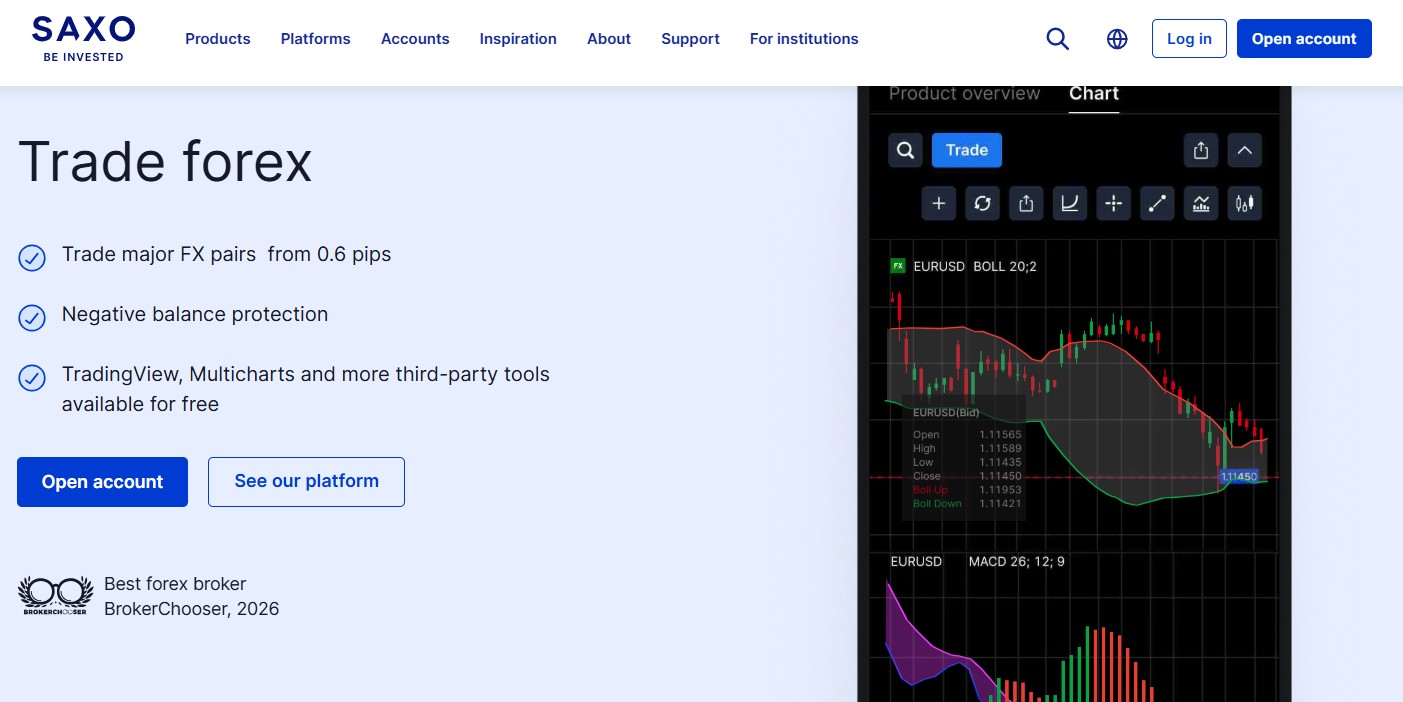
Saxo is not trying to compete with the budget brokers on this list. Saxo Bank is a well-established broker founded in 1992, headquartered in Copenhagen, Denmark. It operates as a licensed Danish bank, which puts it in a different regulatory category from most of its peers. Saxo Bank offers 70,000+ instruments – one of the largest selections in the industry – including 19,000+ stocks, 7,000+ ETFs, 5,000+ bonds, 1,200+ options, 185 forex pairs, and futures.
As a licensed Danish bank, Saxo is supervised by Finanstilsynet (Danish FSA) and regulated by multiple Tier-1 authorities globally. Saxo Bank is regulated by several financial authorities, including ASIC (Australia), FCA (UK), FSA (Japan), SFC (Hong Kong), AMF (France), CONSOB (Italy), FINMA (Switzerland), and MAS (Singapore).
At the time of writing, the average EUR/USD spreads were 0.7, 0.6, and 0.5 pips for the Classic, Platinum, and VIP accounts respectively. Saxo Bank removed inactivity fees in 2024. A custody fee of 0.15% p.a. (minimum €5/month) applies to stock, ETF, and bond holdings on Classic accounts.
Saxo’s leverage limits are conservative by design, in line with ESMA’s standard regulations for retail clients in the UK and EU: up to 1:30 on major forex pairs, 1:20 on non-major FX, gold, and primary indices, 1:10 on other commodities, and 1:5 on individual equities.
Best For: Serious multi-asset traders looking for institutional-grade platforms, 70,000+ instruments, and the security of a licensed bank
Pros:
- 70,000+ instruments
- Operates as a licensed bank
- Tiered pricing rewards volume traders
- No inactivity fees since 2024
- Institutional-quality platforms (SaxoTraderGO and SaxoTraderPRO)
Cons:
- Custody fee on Classic accounts for stock/ETF/bond holdings
- High minimum for Platinum tier ($200,000)
- Limited payment methods
| Avg EUR/USD Spread | 0.7 pip (Classic); tighter at higher tiers |
| Max Leverage | 30:1 (EU/UK retail); up to 100:1 (professional) |
| Min Deposit | None (Classic); $200,000 (Platinum) |
6. Capital.com: Best for Low Minimum Deposit and AI-Assisted Tools
Capital.com was founded in 2016 and is headquartered in Limassol, Cyprus. It is the youngest broker on this list by some distance, but it is regulated by top-tier authorities like the FCA, ASIC, and CySEC, offering strong fund protections like segregated accounts and FSCS coverage.
Commission-free trading costs on the benchmark EUR/USD currency pair average 0.6 pips or $6 per 1 standard lot. The minimum deposit amount for bank cards (Visa/MasterCard/Maestro) and Apple Pay is $10 USD/EUR/GBP (or currency equivalent). With access to 6,400+ tradable instruments including 138 forex pairs, 477 cryptocurrencies, and 5,400 stocks, Capital.com caters to diverse trading strategies.
Retail traders at Capital.com get maximum leverage between 1:20 and 1:30 at all operating subsidiaries, dependent on the geographic location of traders. The broker has a fee of $10 USD (or equivalent) if an account is inactive for six months – a shorter grace period than most competitors.
Best For: New traders wanting a very low entry barrier, competitive spreads, broad instrument range, and AI-powered trading tools
Pros:
- Low minimum deposit from $10
- 0.6 pip average EUR/USD spread
- 6,400+ instruments
- 24/7 customer support
- FCA, ASIC, CySEC regulated
Cons:
- Inactivity fee after only six months (shorter than peers)
- Spreads can widen substantially during volatile sessions
- Not available for US clients
| Avg EUR/USD Spread | 0.6 pip |
| Max Leverage | 30:1 (retail) |
| Min Deposit | $10 (card); $20 (most other methods) |
7. Spreadex: Best for UK Spread Betting with Fixed Spreads
Spreadex is the most UK-specific broker on this list. Founded in the UK in 1999, Spreadex is a large sports and spread betting broker with a CFD division that offers a low-cost trading environment on a wide range of tradable assets. Spreadex is regulated by the FCA.
Spreadex offers one live commission-free CFD account with no minimum deposit requirement and spreads starting at 0.60 pips on the EUR/USD, which is significantly tighter than other similar brokers. Spreadex also stands out for the number of financial assets on offer, including over 3,000 share CFDs, 200 ETFs, over 60 forex pairs, 31 commodities, indices, and a small range of cryptocurrencies (though under FCA regulations cryptos are only available for professional traders).
Unlike many of its competitors, Spreadex charges no inactivity fee. For UK residents, profits from financial spread betting are currently free from Capital Gains Tax and Stamp Duty. Some drawbacks for traders considering Spreadex are that it offers no demo account – an unusual move considering it only offers trading on its proprietary platform. It also offers little in the way of educational or market analysis materials, forcing beginner traders to educate themselves elsewhere.
Best For: UK traders who want fixed spreads and tax-free profits through financial spread betting on its proprietary platform.
Pros:
- 0.6 pip EUR/USD fixed spread
- No inactivity fees
- Tax-free spread betting profits for UK residents
- FCA regulated since 1999
Cons
- UK-only service
- No demo account
- Limited education and research tools
- Leveraged crypto only available to professional traders
| Avg EUR/USD Spread | 0.6 pip |
| Max Leverage | 30:1 (retail, FCA) |
| Min Deposit | £1 |
What to Consider Before Choosing a Forex Broker
Forex may be simple at its core, but there is plenty worth knowing before you step in. Here are the key things to know before starting.
Regulation
Regulation is important, as the jurisdiction in which a broker is regulated determines your compensation rights, the maximum leverage available to you, and whether your funds sit in segregated accounts away from the broker’s own capital. The FCA, for instance, protects its clients by ensuring brokers segregate client funds from operating capital, restrict leverage to 30:1 for forex trading, and provide all clients with negative balance protection, meaning traders can never lose more money than they have in their trading accounts. Tier-1 regulators – the FCA, ASIC, CySEC, BaFin, and Denmark’s FSA – impose the most demanding requirements. Always verify which entity your account sits with, as protection levels can vary significantly between a broker’s different regional arms.
Pricing
Every broker makes money somehow. Spread-only brokers build their revenue into the bid-ask gap. Commission-based accounts offer tighter raw spreads but add a per-trade fee. Neither model is inherently better – the right choice depends on how frequently you trade. It is always important to examine the average spread, rather than the minimum spread, when comparing trading costs across different forex brokers. CMC Markets’ average spreads have historically not deviated much from its advertised minimum spreads, which is one reason it ranks highly in this category. Swap fees – charged on positions held overnight – can also become a dominant cost for traders who hold positions for days or weeks. Check them before opening an account.
Broker and Account Types
Most brokers now offer at least two account tiers: a spread-only account aimed at beginners, and a raw-spread commission account for active traders. Pepperstone offers two primary accounts – Standard and Razor – designed to cater to the trading needs of beginners through to advanced traders. Some brokers, like Saxo, operate a tiered system where the Classic, Platinum, and VIP levels offer progressively tighter spreads in exchange for larger minimum deposits. Confirm what account type you are opening and whether the terms can change based on your volume.
Leverage
Leverage amplifies both gains and losses. In the UK and EU, ESMA caps retail forex leverage at 30:1 on major pairs and lower on more volatile instruments. Some offshore entities offer significantly higher leverage, but the reduced regulatory protection that comes with them is a real cost, even if it does not show up on a fee schedule. Research from the Bank for International Settlements showed that higher leverage increases the probability of triggering a forced liquidation. Some studies indicate accounts utilizing over 50:1 leverage face triple the stop-out risk compared to those employing 20:1 or below.
Range of Currency Pairs
The major pairs – EUR/USD, GBP/USD, USD/JPY – are available everywhere. Where brokers differ meaningfully is in minor and exotic pair coverage. CMC Markets lists over 330 currency pairs, from majors like EUR/USD to exotics like USD/TRY. At the other end of the scale, eToro offers 56 forex pairs. If you plan to trade beyond the majors, check pair availability before committing.
Features and Tools
Platform quality is easy to underestimate until you are in a fast-moving trade. Charting depth, order types, API access, automated trading support, and integrated news feeds all matter. XTB’s xStation 5 platform is well designed and packed with innovative features. CMC Markets offers trading on MT4, MT5, TradingView, and its own NextGen platform that features numerous technical and fundamental analysis tools. Third-party platform support – particularly for MT4 and MT5 – is relevant if you use automated strategies or third-party indicators.
Minimum Deposit and Payment Methods
Minimum deposit requirements range from effectively nothing (Pepperstone, XTB, CMC Markets) to tens of thousands of dollars at premium tiers. eToro’s minimum deposit varies by region. For most countries it is $50, though in some places it can go into the thousands. Payment method availability also varies: Pepperstone added Apple Pay and Google Pay in 2025, while Saxo accepts only a limited range of funding currencies. Confirm your preferred deposit method is available before completing registration.
User Experience
A clean interface is not just aesthetics – it affects execution speed and error rate under pressure. Capital.com’s web and mobile platform is praised for ease of use by many traders. eToro’s platform is intentionally simplified to serve its social trading model. CMC Markets’ NextGen platform skews toward experienced traders with its depth of charting options. Match the platform to your skill level rather than defaulting to the one with the most features.
Mobile Trading
Every broker on this list offers a mobile app, but quality varies. eToro has designed user-friendly mobile apps for Android and iOS devices, with real-time market data, intuitive navigation, and the ability to execute trades with a simple tap. Saxo’s SaxoTraderGO mobile app offers full trading functionality across 70,000+ instruments. If mobile-first trading is your priority, test the app on a demo account before funding.
Customer Support
Pepperstone offers award-winning customer support via telephone, email, or live chat, with response times under five minutes during testing. eToro provides customer service via live chat with agents available Monday through Friday from 8 a.m. through 8 p.m. EST, with automated chat available 24/7. Capital.com states that it offers round-the-clock client support, available 24 hours a day, 7 days a week. No broker on this list offers weekend telephone support – a limitation worth factoring in if you trade over weekends.
Forex Trading Fees Explained
Let’s explore how and where fees creep into the occasion.
Spreads
The spread is the difference between the price a broker will buy a currency (bid) and the price it will sell it (ask). It is how most retail forex brokers make their money. When trading forex, the spread – the difference between the bid and ask price – directly affects your profits. A lower spread means lower trading costs. On the EUR/USD – the world’s most traded pair – spreads vary considerably across brokers. Most good brokers have an average spread of 0.9 pips on EUR/USD. Pepperstone’s Razor account sits well below that average; eToro sits above it.
Spreads are either fixed or variable. Fixed spreads do not change with market conditions – Spreadex’s fixed 0.6-pip EUR/USD spread held steady even during NFP announcements. Variable spreads can tighten during liquid sessions and widen sharply during volatility. Capital.com’s EUR/USD spread from 0.6 pips sounds competitive, but during news releases in testing, spreads widened to 2.5+ pips – wider than most competitors.
Commission
Commission-based accounts separate the spread from the broker’s fee. CMC Markets’ FX Active account features 0.0 minimum spreads on six major FX pairs and charges a 0.0025% commission. The total cost of a commission trade is therefore the sum of the (usually very tight) spread plus the commission per side. For high-volume traders, the all-in cost on a commission account is typically lower than on a spread-only account – but the maths only works if you are trading frequently enough to benefit from the tighter underlying spread.
Overnight (Swap) Fees
Any leveraged position held open past the daily rollover time incurs a swap fee, also called an overnight or rollover rate. Overnight rates are the interest charged or paid when a CFD position is kept open overnight. These rates may also be called rollover or swap fees, and they can be negative or positive. Swap rates are calculated from the interest rate differential between the two currencies in the pair. Positions in the direction of the higher-yielding currency may actually earn a positive swap, while positions against it incur a cost. For traders who hold positions for days, weeks, or longer, cumulative swap fees can exceed the spread as the dominant trading cost.
Non-Trading Fees
Look beyond the trading costs. eToro charges a $10 monthly fee if an account has been inactive for 12 months. Capital.com’s inactivity fee triggers after only six months of inactivity. Spreadex charges no inactivity fee at all. Saxo applies a custody fee of 0.15% p.a. (minimum €5/month) to stock, ETF, and bond holdings on Classic accounts. Withdrawal fees are another variable: eToro charges a $5 withdrawal fee for every withdrawal request from a USD investment account to an external account.
How to Start Forex Trading
The steps below use eToro, as it is the most accessible entry point on this list for new traders.
1: Open an Account
Visit the eToro website and click “Sign Up.” The online application requires a desired username, email address, and password, but traders may also open an account with their Google or Facebook IDs.
2: Verify Your Identity
Complete KYC verification by uploading a government-issued ID and proof of address. While account verification is not necessary to send a deposit of up to $2,250, it is required to withdraw funds – traders should complete it by sending a copy of a government-issued ID and one proof of residency document.
3: Fund Your Account
Head to the deposit section of the platform. eToro accepts payments via bank wire, credit and debit cards, several e-wallets, and eToro Money. Note that eToro converts all non-US Dollar deposits into US Dollars, and traders must account for currency conversion fees.
4: Explore the Platform
Before placing a live trade, use eToro’s virtual trading mode. eToro’s $100,000 demo account allows beginners to start without risking real money. Familiarize yourself with the order ticket, charting tools, and watchlist before going live.
5: Place Your First Trade
Search for your chosen currency pair, review the current spread and leverage settings, and place your first position. Retail clients benefit from negative balance protection, meaning traders can never lose more money than they have in their trading accounts.
6: Set Risk Management Parameters
Apply a stop-loss and take-profit to every trade before confirmation. No order should be left without defined risk parameters, regardless of how confident you feel about the position.
Expert Tips Before Trading Forex
Understand what you are actually paying. The headline spread is not the whole cost. Swap fees, conversion charges, and withdrawal fees can all accumulate. Run the numbers on a typical trade before you open an account, not after.
Use leverage carefully and deliberately. Retail forex leverage under FCA regulation is restricted to 30:1. That is still substantial: a 30:1 position means a 3.3% move against you wipes out your entire margin. Most experienced traders use far less than the maximum available.
Set a firm budget before you start. Decide in advance the maximum amount you are willing to lose in total and per trade. Do not fund your account with money you cannot afford to lose, and do not add more capital to try to recover losses.
Check that the broker is licensed for your country. Pepperstone is regulated in the UK and Australia but is not licensed to operate in the United States. CMC Markets has no US access due to regulations. Verify your broker’s license with the relevant national regulator’s public register, not just the broker’s own website.
Match your account type to your trading style. A spread-only account is simpler and typically fine for infrequent traders. A commission-based account like Pepperstone’s Razor or CMC’s FX Active becomes cost-effective only above a meaningful monthly volume threshold. If you are trading more than five standard lots monthly, the Razor saves money. Below that threshold, Standard’s simpler pricing often matches or beats Razor once commissions are factored in.
Demo accounts exist for a reason – use them. Every broker on this list except SpreadEx offers a demo account. Test your strategy in real market conditions with virtual money before committing capital. An edge that works in theory will often look very different when live spreads, slippage, and swap fees enter the equation.
Be cautious of offshore entities. Several brokers on this list offer higher leverage through subsidiaries in Seychelles, Belize, or the Bahamas. The leverage is real. So is the reduced protection. Retail clients in the UK, EU, and Australia are better served by the entities regulated by their domestic authorities.
Conclusion
eToro leads this list for traders whose primary interest is social and copy trading – nobody else does it better at the retail level. For traders focused on raw cost, Pepperstone’s Razor account is difficult to beat. CMC Markets earns its place for anyone who needs breadth: 330+ currency pairs, multiple platforms, and a genuine no-minimum-deposit policy.
XTB is a strong all-round choice for beginners, combining regulatory credibility with an accessible platform and a $0 minimum deposit. Saxo occupies a different category from the others – its value is in instrument breadth and institutional infrastructure rather than low spreads or easy onboarding.
Capital.com is worth considering for its very low minimum deposit and broad instrument access. SpreadEx is almost exclusively relevant for UK traders, but for that audience, its fixed spreads and CGT-free spread betting offer a genuinely distinctive proposition.
For most retail traders starting out, eToro will be the most practical starting point.
Capital is at risk on all products covered in this article. CFDs are complex instruments and a significant percentage of retail investor accounts lose money trading them. Verify current terms and regulatory status directly with each broker before opening an account.
How We Compared and Rated Forex Brokers
Our methodology for ranking forex brokers focuses on filtering out the excess noise in a saturated market. We ignore marketing claims and grade platforms entirely on client protection and how they work from a user perspective.
We only look at platforms with active oversight from major regulators (primarily the US, UK, Europe, and Australia). If a broker has a history of security breaches or issues with regulators, it is not eligible for testing.
For the platforms that pass these checks, we score the actual software and trading experience. We log in to measure live spreads, test the available forex pairs, and use the mobile apps. We look at minimum deposits, rates, and will often contact customer support.
FAQs
Which forex broker is best for beginners in 2026?
XTB and eToro are the strongest options for beginners. XTB’s xStation 5 platform and comprehensive education helped the broker finish Best in Class for Overall, Ease of Use, and Beginners in 2026. eToro’s intuitive interface, $100,000 demo account, and CopyTrader make it easy for beginners to start without risking real money. eToro’s copy trading adds a layer of accessibility that purely platform-focused brokers do not offer.
Which forex brokers accept US traders?
This is a short list. Pepperstone is not licensed to operate in the United States. CMC Markets has no US access due to regulations. SpreadEx accepts clients from the UK only. eToro operates in the US through eToro USA Securities Inc., a FINRA and SIPC member, though the product offering for US clients is more limited than in other jurisdictions. Saxo also does not service US traders. Always confirm current availability on the broker’s own website.
What is the difference between a spread and a commission in forex trading?
A spread is the built-in gap between the buy and sell price on a currency pair – you pay it on every trade, whether you see it itemized or not. A commission is a separate, explicit fee charged per lot traded, typically used alongside a tighter raw spread on ECN-style accounts. CMC Markets’ FX Active account features 0.0 minimum spreads on six major FX pairs and charges a 0.0025% commission. For high-frequency traders, commission accounts with tight spreads can be cheaper overall; for casual traders, spread-only pricing is simpler.[/A3]
Is forex trading available on mobile apps?
Yes, all seven brokers on this list offer mobile apps for iOS and Android. Saxo’s SaxoTraderGO mobile app offers full trading functionality across 70,000+ instruments. eToro has designed user-friendly mobile apps with real-time market data, intuitive navigation, and the ability to execute trades with a simple tap. Platform quality does vary – test any app on a demo account before relying on it for live trading.
What leverage is available to retail forex traders in the UK and EU?
Under ESMA’s standard regulations for retail clients in the UK and EU, leverage is capped at 1:30 on major forex pairs, 1:20 on non-major FX, gold, and primary indices, 1:10 on other commodities, and 1:5 on individual equities. Traders who qualify as professionals can access higher leverage, but doing so means waiving certain retail protections including negative balance guarantees and access to compensation schemes in some cases.
Do forex brokers charge for inactivity?
Some do, some do not. eToro charges a $10 monthly fee after 12 months of inactivity. Capital.com applies an inactivity fee after only six months. Saxo Bank removed its inactivity fee in 2024. Spreadex charges no inactivity fee. Pepperstone does not charge any inactivity fees. If you trade infrequently or plan to keep a dormant account, verify the broker’s policy before funding.
Are forex trading profits taxable?
Tax treatment depends on your country of residence and how you trade. In the UK, profits from financial spread betting are currently exempt from Capital Gains Tax and Stamp Duty. For UK residents, profits from financial spread betting are currently free from Capital Gains Tax and Stamp Duty – though tax laws can change. CFD profits in the UK are subject to CGT. Always consult a qualified tax professional for advice specific to your situation.